In My Travel Opinion: Staycationing in Scotland

Scotland postcard

There are always two sides to every story.

Take the ‘news’ today that a few restaurants in the South West have left the Eat Out to Help Out scheme, complaining of overcrowding Monday – Wednesday and empty tables the rest of the week. That’s fair enough. But from my perspective, it’s a fantastic offer and I’ve enjoyed dining out in Sherborne in Dorset a few times. What’s more, I’ve noticed both cafes to be quite busy on other days.

Meanwhile in Scotland, there are tales that a new type of tourist has been invading Scotland since July: the ‘dirty’ or ‘clatty’ camper.

The Clatty Campers
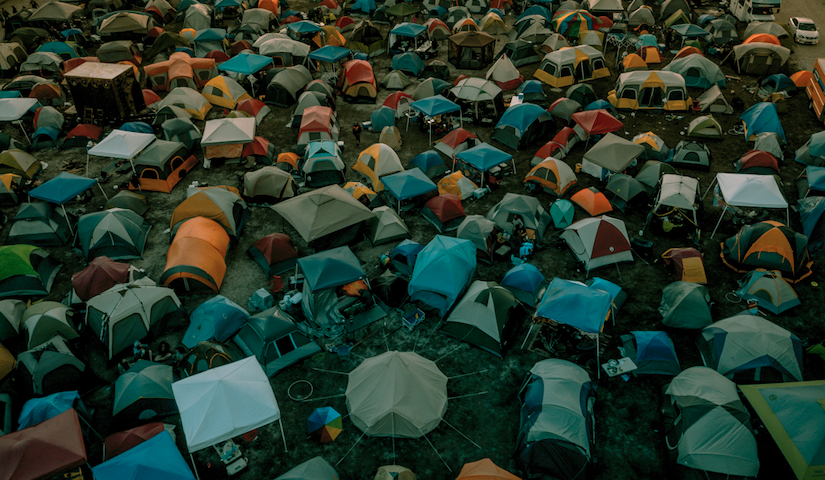
A field filled with tents
Crowded tents by Edward Paterson

I first heard about the problem a few weeks back on the BBC radio programme Scotland Outdoors. Presenters Mark Stephen and Euan McIlwraith chatted to campaigner Anne Widdop who was very quite impassioned, shall we say, about what’s going on in Morar, Western Scotland:

It started on 11th July, before the 5 mile travel ban had been lifted. We had 42 tents appear on Morar beach, basically a shanty town of tents, cheek by jowl. The road was blocked with cars and camper vans, the bins were overflowing, people dumping rubbish in every nook and cranny. After the weekend, [there were] abandoned tents, camping gear, fire pits, destroying the marram grass. And the human excrement everywhere…it’s truly awful. It really is the wholesale desecration of an internationally important habitat. The responsible, sensible visitors are already saying they don’t want to visit and they don’t want to come back, entirely due to this.

Yet, when one of the presenters journeyed over to the popular Hebridean island of Mull, he found… nothing out of the ordinary. You have to pay to travel over on the CalMac ferry, but that doesn’t stop it being a hugely popular island. Clearly, dirty camping hasn’t reached every corner of Scotland.

When I dug a bit deeper to see how related to the pandemic it was, I noticed that ‘car campers ‘, as Anne calls them, aren’t a new phenomenon in Scotland, as this report from last summer shows.

But human poop in bins is not something any local should have to deal with. Couldn’t the council be doing more to assist?

Under increasing pressure, some councils are responding. Lochbroom Community Council, responsible for the area around Ullapool on the North West Coast, announced a few days ago that they’d be increasing signage towards open facilities and putting out trowels in lay-bys, as an ‘emergency last resort’ for drivers.

The Vast Majority

Three sheep in a field
Sheep on the island of Mull

The truth is, though, that the majority of Scotland’s visitors seem to be behaving themselves. Summer is always going to be a bit of a stress on locals, but perhaps it can be slightly blown out of proportion. That’s the impression I get anyway. When I asked a friend from Dundee if she’d heard of any incidents, she hadn’t. In her view, for the most part ‘locals have a charmed life up there.’

And, despite recent calls on the people behind the popular North Coast 500 driving route to stop advertising, Scotland’s tourism business can’t do without visitors. And there are plenty on their way to drive along those roads, given how much accommodation appears to be fully booked through September.

If facilities are closed, you surely can’t entirely blame tourists when nature calls. Councils should adopt more ideas from mainland Europe and New Zealand, such as creating Aires, which are car park or farm pitstops designated for caravans or cars, often free of charge. Creating permit systems for cars in beauty spots is another idea.

But with options like this not yet a reality, VisitScotland has its work cut out for the rest of the year to encourage tourism, curb dirty camping and keep locals happy. Last Monday, its Chief Executive Malcolm Roughhead promised to step up efforts, targeting novice campers and encouraging them to use official campsites.

‘I think it’s been about people who are maybe [new] to the countryside not understanding the access code, and not understanding that we have to protect those assets’.

So, how to avoid the ire of locals, and be a considerate visitor?

1. Be responsible
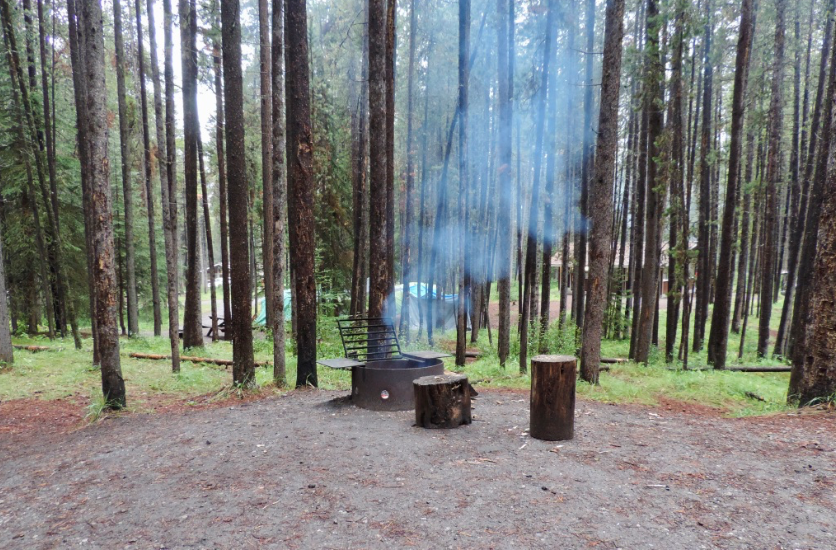
In the forest on a campsite at Banff National Park
A campsite in Banff National Park. We could learn a thing or two from how things are organised in North America.

The access code that the chief of VisitScotland mentions is the Scottish Outdoor Access Code. All 135 pages of it.

I’m going to bet a haggis that few members of the public have read the entire code, word for word.

So here’s a summary:

  • Take responsibility for your own actions – eg. care for your own safety, keep alert for hazards, take special care with children.
  • Respect people’s privacy and peace of mind – eg. do not act in ways that might annoy or alarm people, especially at night.
  • Help land managers and others to work safely and effectively  – eg. keep clear of land management operations like harvesting or tree-felling, avoid damaging crops, leave gates as you find them.
  • Care for your environment – treat it with care. Don’t disturb wildlife and take your litter away with you. [And don’t shit in bins].
  • Keep your dog under proper control – dogs are popular companions, but take special care if near livestock, or during the bird breeding season, and always pick up after your dog.
  • For a slightly expanded version, check out this leaflet.

It’s just common sense really – something you all have, friends of the blog!

2. Wild camp like a wild camper

Two tents on a remote mountainside
Wild camping by Dino Reichmuth

Because of the 2003 Scottish Land Reform Act, the country has some of the best access rights in the world. This means that wild camping is easier. But common sense, and the code, state that even when wild camping, you should look to seek permission from landowners.

From what I’ve read, many locals and landowners are only too happy to assist in explaining where is best to wild camp, because it means that it’s being done responsibly, and you’ll be more comfortable too. Result.

Camping right next to a ‘do not camp here’ sign on the other hand? Not cool.

3. Support hostels

Gearrannan Hostel on Lewis in the Outer Hebrides

If you prefer a bed to a sleeping bag, booking before you go is pretty essential, unless you’re told otherwise. Some accommodation owners are understandably stipulating that walk-ins and on the day bookings won’t be possible.

A large part of this is down to the distance between guests that’s required under Covid regulations. As you’d expect, hostels have taken a huge hit because you can’t have strangers staying together in dorms.

But a healthy number are open for business. For groups of family or friends it can be good value to take over a dorm or even a whole hostel. Always worth seeing if there’ll be a hostel near you to support; You can search hostels across the UK via the Independent Hostels website or browse Scottish Youth Hostels, who have seven hostels open at the moment (if you include Cairngorm Lodge, recently renovated and re-opening on 20th August).

4. Go remote
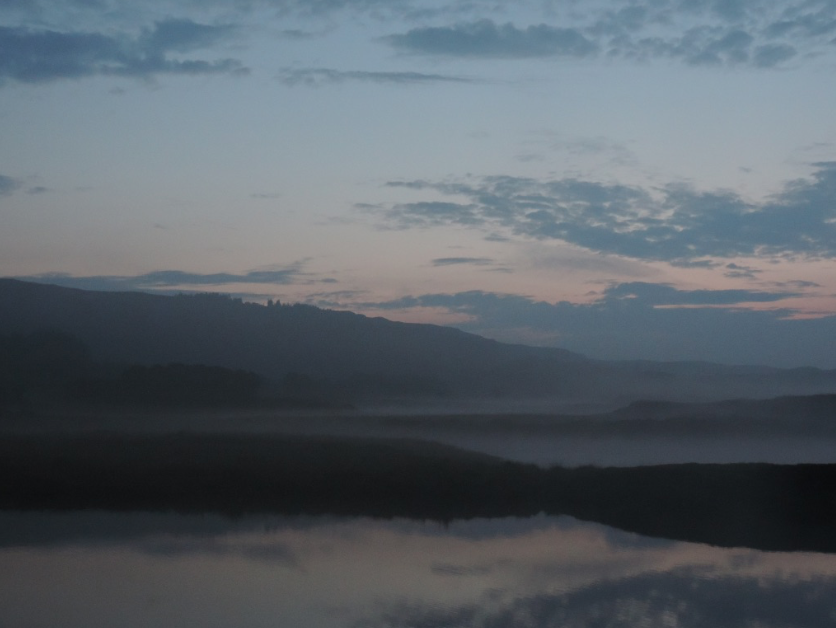
Outlines of a loch and mountains in a remote corner of Mull
A remote corner of Mull

It can be hard to judge how popular or overcrowded certain spots will be, particularly given that Scots are rightly staycationing in their own country, reaching further afield than outsiders might. Google maps is quite handy for zooming in to remote locations to find off the beaten track accommodation. And even small villages can have their own websites with great local information.

So far though, I’ve found islands such as Orkney, Shetland and those in the Outer Hebrides (famous last words) to have the most availability at the moment. And I love how well-covered the islands are by public transport, helping those who can’t drive (like me).

And if you just can’t seem to find anything in a specific location, ask a host who is fully booked where else they’d recommend you try. Or go wild…

Me? From early September I’ll be up on the North Coast before sailing out to live the island life for a bit. Question is, what side of the story will we fall on?

You’ll have to wait and see – but whatever we do, I hope it’s not clatty.

Photo Story: London Revisited

My friend Poly sent me a photo last week from Brockwell Lido before a swim. Quiet, peaceful, serene. I remember queuing with my housemate Giada for five hours to get in on a hot day once. It was brutal, but as soon as we laid our towels down and jumped in the water…glorious. With a hefty pang of jealousy, I realised I miss London…

It’s been my home for 28 years but for the foreseeable future I’ll be down in Somerset. This loveliest of lidos got me thinking about the other spots around town that I can’t wait to revisit. Read on for some of my favourite places in London.

What do you enjoy most about London? I’d love to hear from you in the comments!

Shakespeare’s Globe

Globe Theatre inside
Shakespeare’s Globe, from the yard
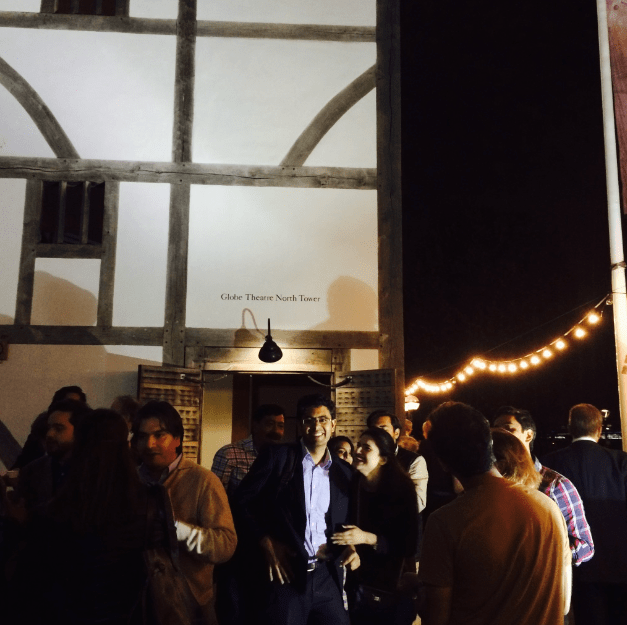
Outside the globe after a play has finished
After a performance

I have honestly lost count of the number of plays I’ve seen at the Globe. Often with a cold cider in hand, standing amid a sea of Yardlings (it costs £5 to stand), admiring another brilliant staging of a play. When it’s safe to visit again, I’ll be first in line.

Current status: The Globe has got all sorts of great content on its YouTube channel, including actors reading Shakespeare’s sonnets.

London restaurants

Picasso Afternoon Tea at Rosewood London
The Picasso Afternoon Tea at Rosewood London

Far too many epic eats to ever commit to choosing my best or favourite restaurants in London, but here are three venues I really miss right now…

Lina Stores pasta and cocktails
Hazelnut and pumpkin ravioli in the foreground, and a pomelo martini

Lina Stores, Greek Street

When I next visit I’ll be asking for fresh crab linguine and a beautifully scented pomelo & basil leaf martini. I’m also excited that the Lina Stores Italian deli is back open on Brewer Street.

Roti and curries at Roti King
Roti Canai served with dhal and kari, and a side of fried veggies

Roti King, Euston

The sight of roti being made in the kitchen at Roti King is a heavenly one. They’ve just reopened for dining in, serving their roti alongside varying curries, or their classic lentil dhal.

Chicken BAO burger
Chicken bao burger and sweet potato fries

BAO London

All the baos at BAO, please! For anyone who in the past has queued on the pavement for ages getting rained on, it feels like a bit of a silver lining that it’s reservations only at the moment!

Olympic Park, Stratford

Olympic Stadium in Stratford
The Olympic Stadium

The Olympic summer of 2012 in London still feels like a dream. My brother and I were incredibly fortunate to see lots of sports including a few athletics sessions in the Olympic Stadium in Stratford. I’m sure I got laryngitis from all the cheering. The beautiful Queen Elizabeth Olympic Park outside is a testament to how well the games were thought out.

Alfred Dock

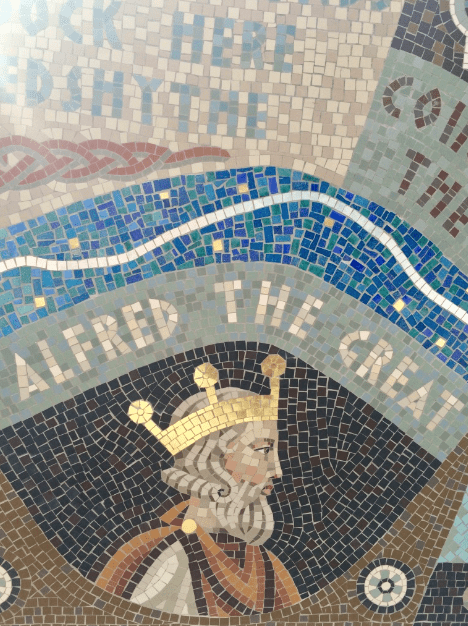
Mosaic at the King Alfred Dock
The Mosaic on the walls by the dock

In the tiny area of Queenhithe in the City of London, walk along the Thames and you’ll find a slice of Anglo Saxon history. The Alfred Dock dates from at least 886 AD, when King Alfred the Great restored English rule to London, following decades of Viking raids and disputed control.

Current status: accessible to the public, or if you can’t get there you could always watch Last Kingdom on Netflix…

Kew Gardens

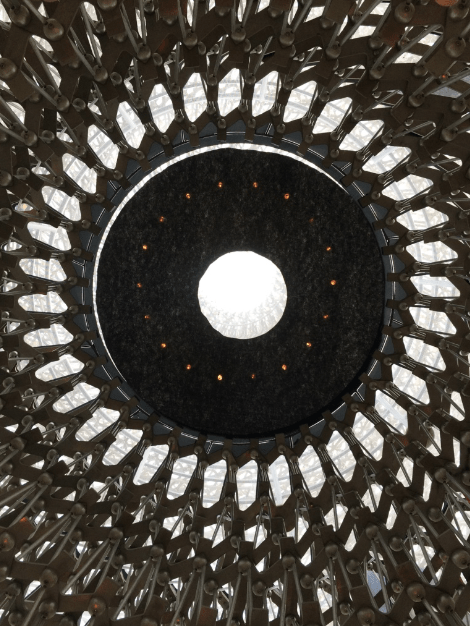
Inside the Hive installation at Kew Gardens
Inside the hive at Kew Gardens
Water on leaves at Kew Gardens

A literal breath of fresh air, stunning in every season and an antidote to all of life’s stresses.

Current status: Kew has been open for a while now, though some of their indoor offerings such as their art galleries have been off limits. Can book here for Kew and its sister venue, Wakehurst.

Royal Opera House

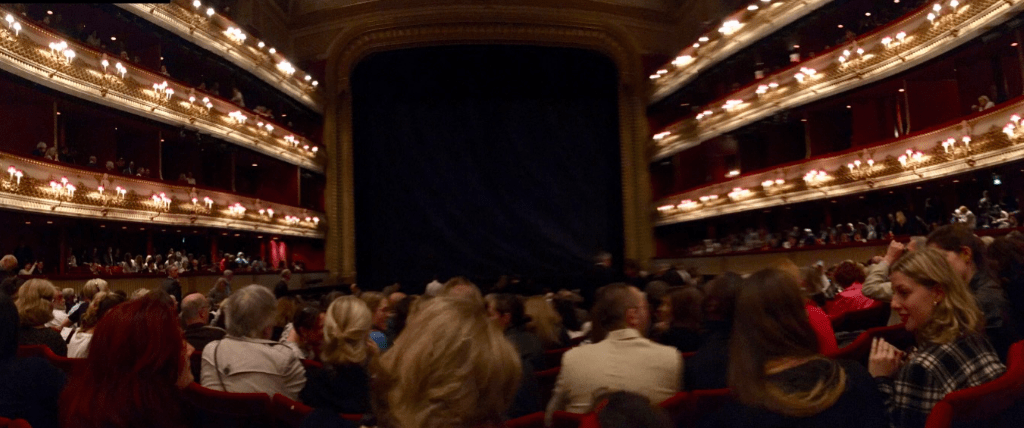
Inside the Royal Opera House auditorium
Curtain about to rise on a performance of Mozart’s The Magic Flute

Beautiful ballets and epic operas. Following a huge refurb, the Royal Opera House’s airy meeting spaces, cafes and bars also make it a lovely place to hang out.

Current status: ROH has had a lot going on digitally, including this live staging back in July of new and favourite ballets and opera works, set against the backdrop of their lamplit auditorium.

BFI London Film Festival

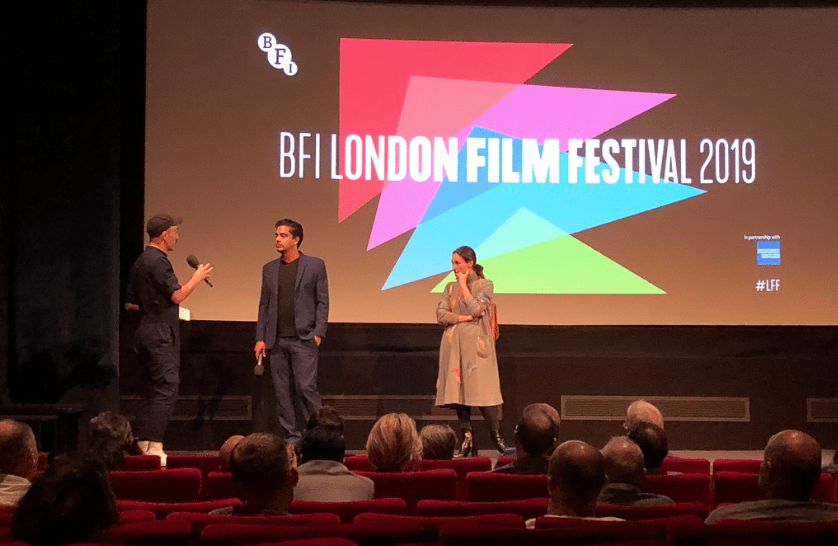
A screening at the 2019 BFi London Film Festival

Ok, so it’s not technically one place because it pops up all over London, but it’s a bloody good festival. Red carpets, dark room Q&As and a chance to see unexpected, surprising films from around the world. London is lucky to have such a celebration of film each year. And this October it will be UK-wide as everything is going digital.

Current status: The BFI LFF 2020 programme will be announced in early September.

Wimbledon

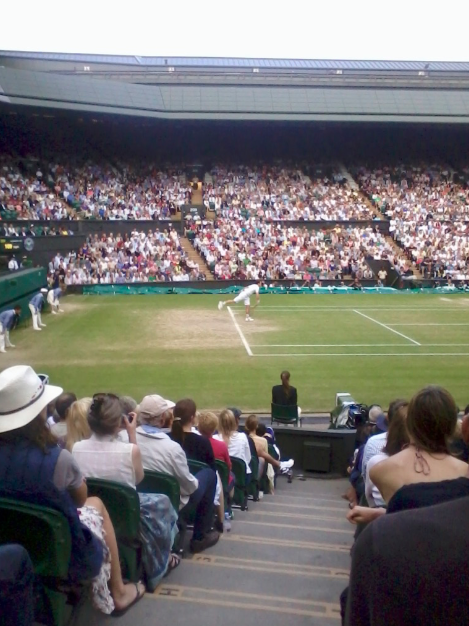
Andy Murray serves during the Semi Final of the 2013 Wimbledon Championships
Andy Murray about to smash Jerzy Janowicz in the semi final, the year he won Wimbledon

From the moment I first walked into the Wimbledon grounds with my uncle and brother, that was it. Smitten. I’ve camped, queued, gone after work and been up before dawn. Ballot tickets are how a lot of people visit, but you can actually get tickets daily on Ticketmaster, for all the show courts. That’s how I got a semi final ticket to see Andy Murray on his way to winning his first Wimbledon.

Current status: Wimbledon cancelled the tournament for the first time since World War II so the 134th championship will take place next year instead. Double portions of strawberries and cream all round I think? Till then, there’s always highlights.

Chinatown

London's Chinatown

It doesn’t matter that it will probably take me years to earn enough points on my Loon Fung supermarket loyalty card to get money off my shopping. It always cheers me up to pace those tiny aisles and afterwards to listen to buskers along the busy street outside.

Current status: restaurants have taken a big hit but the streets of Chinatown are now dotted with tables, which is brilliant. Loon Fung supermarket has been open a while, but it’s quieter than it’s ever been; expect a temperature check and mandatory mask wearing.

Imperial War Museums

Flowers on the guns outside Imperial War Museum London
Flowers on the guns outside IWM London to mark an exhibition opening

I LOVE the museums and art galleries of London with a passion that would make Casanova look tame. As I spent 6 years working in Press and Marketing at Imperial War Museums, I had to give them a mention. IWM is in fact five museums – IWM London, Churchill War Rooms, HMS Belfast (all in London) as well as IWM Duxford and IWM North.

IWM London, where I was mostly based, reopened in 2014 after a huge refurb of its First World War Galleries. In my view, IWM exemplify what all museums should be about – fascinating collections, moving stories and diverse voices.

Current status: sadly HMS Belfast can’t reopen yet but all other sites are now back in business. I’m excited to visit IWM London soon and see Ai Weiwei’s 5 star-reviewed art installation, History of Bombs.

Liberty of London

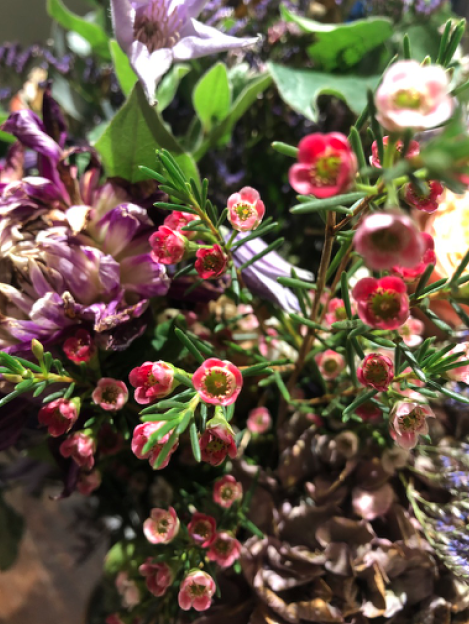
Flowers at Liberty
Flowers from the Wild at Heart florist based at Liberty

As a teenager, I would haul myself from Harrow (Zone 5) into Central London often with the same end goal: to peek at the flowers outside Liberty and gaze at the gorgeous stationary. Nowadays my biggest indulgence is getting my hair cut in their Taylor & Taylor salon. Though it’s been a while…!

Mr Toppers Barber Shop

Mr Topper the Frog, outside one of his barber shops

Last, but never least, it’s true London gent, Mr Topper the Frog! I’ve never been inside Mr Toppers Barber Shop so I can’t vouch for their haircuts, but my brother and I play a game of sending each other a picture of Mr Topper whenever we’re passing one of their branches. Look for him on Moor Street near Shaftesbury Avenue, on Tottenham Court Road or Great Russell Street.

The great thing about London is there’s always something going on around the corner, down an alleyway or through a set of polished doors. London will always be open, and I’ll always call it home.

Rainbow over London's Southbank

Alaska: a tale of two bears

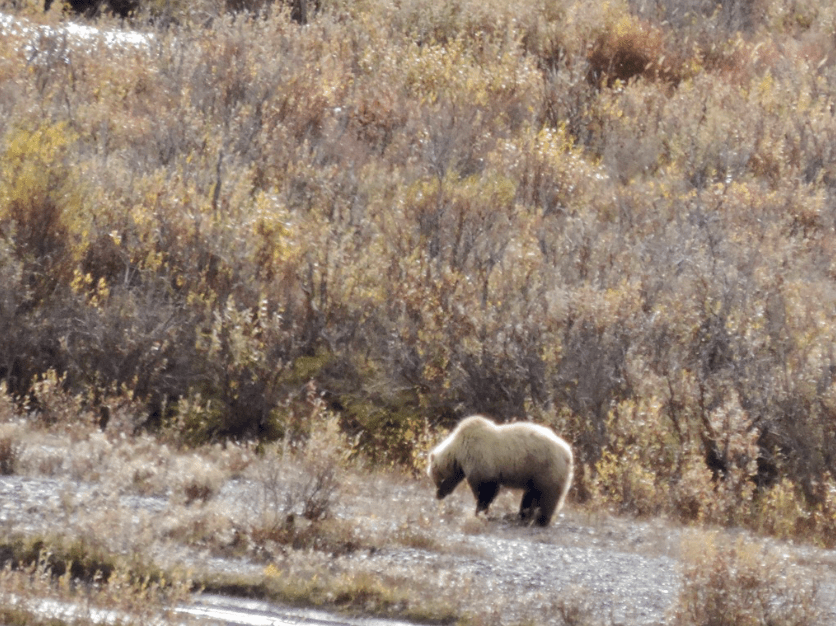
Grizzly bear in the distance at Denali National Park

This bear is a grizzly bear that was supposed to be a polar bear.

Perhaps I should explain.

Outline of the country of Alaska

We made an adventurous plan last year for our September trip to Alaska. We would go way up north to the Inupiaq village of Kaktovik on Barter Island. Each autumn, polar bears gather there, awaiting the ice freeze that accommodates their passage higher into the Arctic Circle over winter.

We booked a tour with Akook Arctic Adventures – owned by local Inupiat Jack ‘Akook’ Kayotuk – that would take us into Prudhoe Bay and the Beaufort Sea to observe as many big furry, four-pawed visitors as we could find in four hours.

This was going to be a wildlife experience of a lifetime. I had even arranged to interview the Akook team for American Airlines’ inflight magazine American Way.

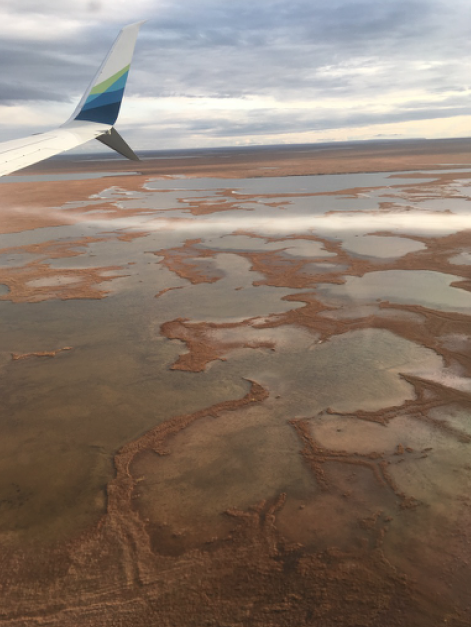
Flying towards the Alaska Arctic Circle

The journey had three stages: fly from Fairbanks in Alaska’s interior to the intriguingly-named town of Deadhorse westward along the coast from Kaktovik; stay overnight with resident oil workers and scientists, then fly across Prudhoe Bay to Kaktovik.

Arctic Fox Airbnb
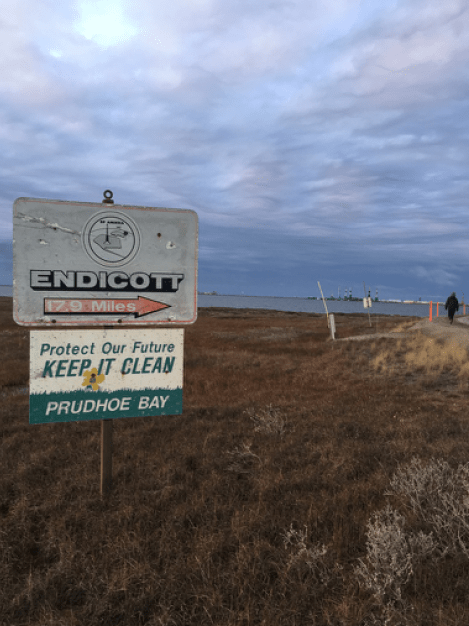
Signs in Deadhorse
The coastline of Deadhorse

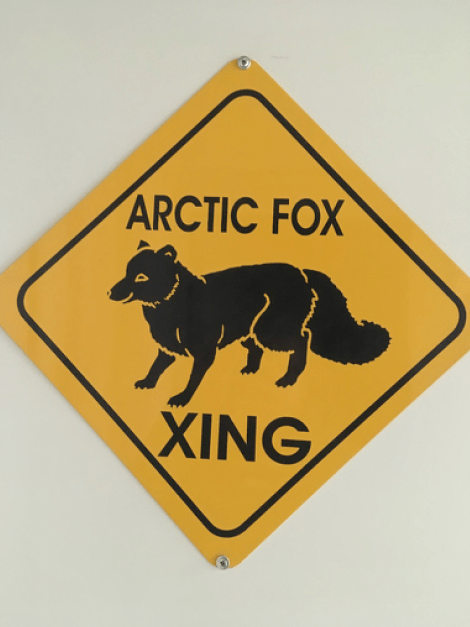
We managed parts one and two very well, settling in to our Deadhorse Airbnb, The Arctic Fox, hosted by a researcher named Tippy. It’s the only place tourists can stay aside from the pricey Prudhoe Bay Hotel (that does at least host a gargantuan buffet every evening. We couldn’t move after).

Part three?

Fog

Fog. We woke up to a sea of thick, opaque fogginess across the town. Our flight to Kaktovik would be delayed, at the very least. The only thing we could do was wait.

Sitting in dinky Deadhorse airport for 6 plus hours, we prayed to the weather gods it would lift. We even watched almost all of the Pirates of the Caribbean franchise on the lounge TV, as a sacrificial offering.

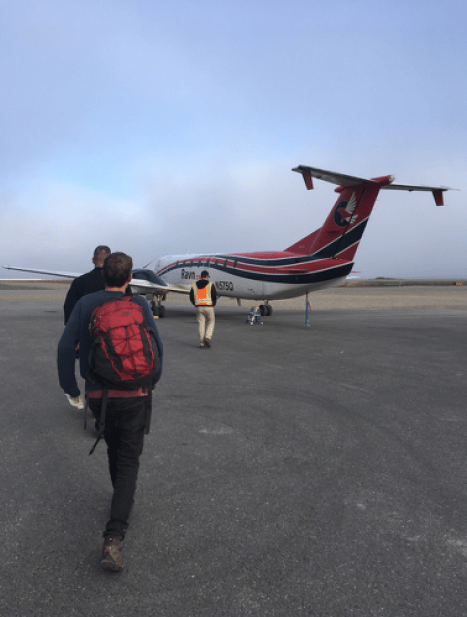
Our mutterings seemed to work. The fog lifted bit by bit as the day wore on, and by late afternoon we were allowed into the sky in our Ravn Airlines turbo prop plane.

Heading onto our flight from Deadhorse
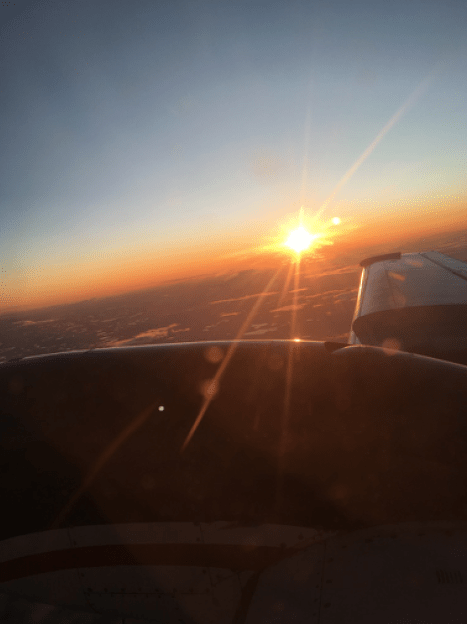
Sun setting from our turbo prop plane

The Arctic was on our wing tips.

High up, we even caught sight of the mighty Denali mountain, spiny with snow that glinted in the slowly setting sun.

Approaching our end destination we startling circling. It was clear that cloud was thick above Kaktovik.

We circled some more.

The pilot advised us that we might not be able to land if he couldn’t get a mile of visibility. He lingered. We begged with those same weather gods. However, the sun setting faster now, and fuel running down, we couldn’t push it any further and had to fly to Fairbanks. Back into the Alaskan interior and far away from where we’d wanted to be.
The weather, and some bad scheduling luck, put paid to our polar bear hopes. Optimism blasted out of us like a frozen breeze through trees, but we couldn’t give up. We had the last days of our trip to plan all over again.

We discussed all kinds of alternative (and outlandish) plans and activities, from trying to hire our own plane to get back up north, to white water rafting, but really there was no contest: we should get to Denali National Park and see North American’s highest mountain peak closer up. Maybe spot some wildlife…

Denali mountain by Joris Beugels
© Joris Beugels
Mount Denali from the Denali train

Denali means ‘the high one’ in Athabascan Indian culture, and it’s a cool 20,310 ft tall. The mountain actually rises higher from its base than Mount Everest, meaning it’s not hard to spot on a good day! You might have heard it called Mount McKinley in the past – not that Alaskans wanted it named after the former U.S. President – but the name was officially changed in 2015, after decades of campaigning.

About those grizzlies.

First thing to say about grizzly bears, aka the North American brown bear: just because there are around 30,000 of them in Alaska, it does not mean they are down every path or lurking behind every tree. But it’s true there’s always a frisson and thrill when you’re hiking in bear country. You expect to surprise one every time you walk a trail, perhaps ending up as a fleshier alternative to the Alaskan bears’ usually berry-rich diet. In reality, bears are far too smart to hang around humans all that much, despite the headlines.

Travelling on foot as we were, and with only one full day to explore Denali National Park itself, we relied on a ranger-driven shuttle bus to take us as far into the park as we were allowed to go.

The bus was crowded when it got to our stop, so we didn’t even know that we’d get on, but get on we did. The ranger/driver hadn’t seen any bears that day, and we told ourselves not to get the hopes up.

Denali National Park

But, as the bus advanced towards the end of its route, the ranger let out a soft cry,

‘There’s a bear, it’s right down there, look!’

Far below us on the left of the road, beautifully blending in with surrounding tufts of orange-brown brush grass, a snoozing male grizzly bear.

Necks craned, cameras jostling, we all squinted for a glimpse of the bear in the distance.

‘Was he there by the curvy bit of river?’

‘No, further forward I thought?’

‘No, that’s a bush.’

‘THERE!’

Without the ranger on hand, he really would have been very tough to spot from that vantage point.

Happy that we’d seen a grizzly, however distantly, we got off the bus expecting that to be all we’d see of him.

Closer up view of a grizzly bear in Denali National Park

But here he was again.

He had sauntered away from the river towards where we now stood, still, utterly under his spell. As he mooched about between grassy clumps and thorny trees, our binoculared gazes avidly followed.

After about half an hour, he sloped off in search of food (towards two walkers who initially looked a lot closer to him than they actually were, phew) and we went our separate ways for a quick hike, turning to look now and again as the bear’s profile shrunk from view.

We were on such a high for the remainder of the trip.

While it had been a crashing disappointment to miss our date out in the snow with Arctic polar bears, we knew how lucky we’d been in Denali. To take the glass half full approach, if we had seen the polar bears, we would never have seen the grizzly!*

Now, if you go down to the woods…

Watch out for grizzly bears

*I’m still pretty p***ed we didn’t see polar bears though.

Postcard from…a Japanese heatwave

Longer read

31° degrees Celsius. 88° degrees Fahrenheit. 70% humidity. Welcome to Kyoto in July.

Or, to be specific, Kyoto in July 2018. In Japan’s ravishing old capital, and across most of Japan, a heatwave was sweeping through, the worst since records began. And there I was, on holiday with my brother.

I’d had big reservations about visiting at the hottest time of year but he was backpacking round Asia and it couldn’t really work outside summer.

We knew it would be uncomfortably hot, scorching even, but it was the humidity that floored us. From dawn until dusk, walking anywhere outside was like battling through a sauna, with a fever. Even armed with an umbrella, cold water, cotton clothes, sunglasses, hats and copious slatherings of sun lotion, the heat was so pervasive, so brutal.

Nijo-jo Castle

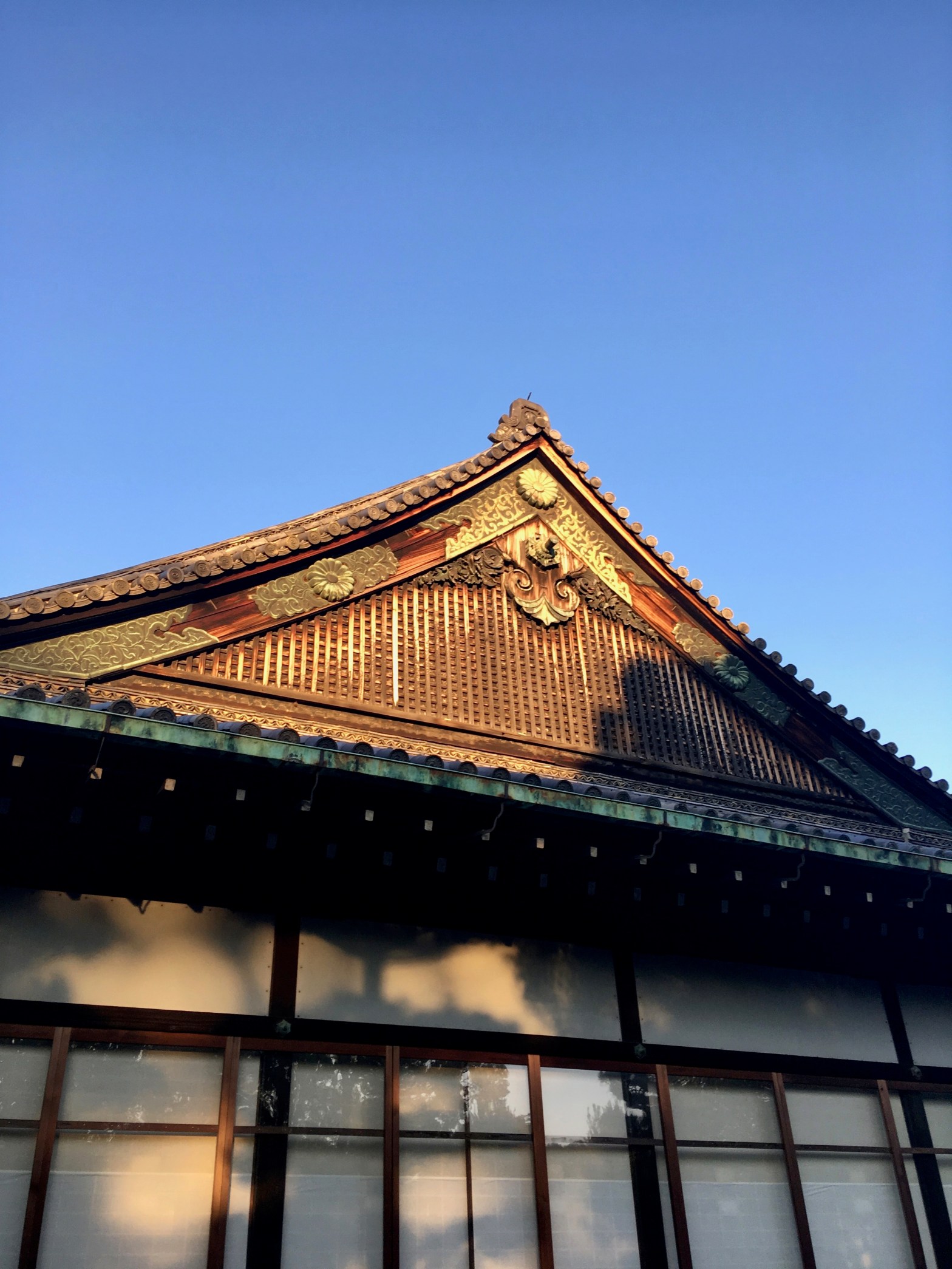
Midway through our stay in Kyoto we decided to visit 400 year old Nijo-jo Castle. It was built in 1603 on the orders of the powerful first Shogun of the Tokugawa Shogunate, a symbol of the beginning of one of the longest periods of peace and stability in Japanese history.

Fast forward to 1867 and within the walls of the castle’s Ninomaru-goten Palace (pictured), the 15th Tokugawa Shogun announced the end of the Shogunate, returning political control to the Emperor and fatefully restoring imperial rule to Japan.

In other words, the sort of place you’d be silly to miss on a first trip to Kyoto.

The 33 rooms of the palace are treasures in their own right, garnished with thousands of golden wall paintings, including the famous tiger and bamboo paintings in the Third Room. Then there are the so-called Nightingale Corridors that sound like birds chirping as you walk through them. It’s caused by the nails in the floorboards, rather than a way to ward off intruders, despite the myth.

Unfortunately all of this was somewhat lost on me that day. You see, I was having a bit of a meltdown.

A packed day

It wasn’t our first attraction of the day, not even our third. That’s how we Crowthers roll.

We got up early to visit the Arashiyama Bamboo Grove (underwhelming and overcrowded if I’m honest. The bamboo groves above Fushimi Inar-taisha Temple are much quieter) and then, as the sun continued its violent ascendency towards midday, we climbed the steep hill of the popular Iwatayama Monkey Park (discovering new meanings for the word ‘sweat’) to watch Japanese Macaques contentedly dive in and out of their pond, cooling down as we could not. Then, the striking Kinkaku-ji Golden Pavilion northwest of the city. I vividly remember the purple irises dotting the shoreline of the lake, whitened by the sun’s rays.

We ran out of water at this point.

Near the exit, we thought we’d found a fountain, like a mirage in the distance. As we got closer we realised it was a hose for watering the foliage. And it was being closely guarded.

By the time we made it to the grounds of Nijo-jo, it was mid-afternoon, the sun in its zenith and our 7-Eleven lunch bags untouched. (Incidentally, the humble 7-Eleven convenience store was a revelation to me. It’s like a Pret, Itsu and corner shop rolled into one. My brother, on a shoestring backpacker budget, practically lived there.)

Hangry

For someone whose life mostly revolves around mealtimes, ‘hungry in a heatwave’ was not a good situation to be in.

We walked through the entrance at Higashi Ote-mon Gate and carried on straight, in zombie fashion, not consulting a map. I’m not even sure I picked one up at this stage. A massive mistake, as we walked straight by a turning for the main (air conditioned) rest area in the whole site.

I won’t fill you in on the colourful language I aimed at my brother for insisting we go straight in without having lunch first, but suffice it to say, we had an argument. Stomping through the castle grounds and garden, I couldn’t see facilities anywhere. Resigned to just eating our lunch on a quiet bench somewhere, the penny dropped that we wouldn’t find any.

If you’ve ever toured any gardens in Japan, you’ll know that they’re so meticulously kept, and often considered so sacred, that eating in them is considered taboo. In fact, eating outside in general is not really the done thing.

But we were getting desperate.

I’m not proud to admit that in a fit of heatwave rage that did my body temperature no favours, I resentfully consented to sit on some shaded (but still volcanically hot) steps to eat. I did cheer up a bit when we found a cold drinks vending machine. They’re everywhere across Japan and often have bins and seating around them, as it’s also considered rude to walk with drinks. I must have bought at least three cans of Fanta in that moment.

The sun must set

So by the time we entered the Ninomaru-goten Palace, with its painted walls, its bird song and all that historical significance, we were knackered.

There was understandably no air conditioning inside the delicately decorated rooms, but few fans either. We had to keep moving along with the steady trickle of visitors and I’d be lying if I said I was taking much in. I kept thinking, ‘this would be so wonderful if I could concentrate’.

Sooner or later, however, day must make way for night. In July, the sun sets between 7-8pm so we had just enough energy to stick around and enjoy the grounds as the golden hues of the setting sun blended into shadows. We discovered outdoor sprinklers you could walk through (why aren’t they everywhere?!), before I rewarded myself with a giant matcha ice cream in the café.

And from that day onwards, we paid more attention to visitor maps…

Impossible without global warming

I couldn’t write about my experience without expanding on the implications and impact of the heatwave.

It was only when I got back to London that I realised how unprecedented it was. It got worse as July. Tens of thousands of people across Japan were hospitalised, while 1,000 died. Coupled with damaging heavy rains and mudslides in late June and early July, 2018 was a year of suffering for the people of Japan.

In 2019 a team of scientists at the Japan Meteorological Agency used a burgeoning technique called attribution science to assess the likelihood of a heatwave in 2018 in a climate-changed world versus a world without global warming and compared the difference:

‘The deadly event of the previous summer could not have happened without human-induced global warming… in a sense, these people are the first provable deaths of climate change’

Like everyone else, I hope the 2021 Olympics go ahead in Tokyo next July, despite this year’s pandemic. But I also hope that we don’t lose sight of what has to be our number one global priority – tackling the climate change emergency.

————–

With the heat here to stay for now, I put together ten tips for staying cool in extreme heat. Some are very common sense, but as I didn’t follow half of them myself when I arrived in Asia, they seemed worth including.

Postcard from…Tokyo

Tokyo 2020. As I write this, the opening ceremony of the Olympic Games ought to have been in full sway, knocking our socks off with pageantry, pride and prowess.

But, as the Japanese proverb goes, we learn little from victory, much from defeat.

And so we can all look forward to a re-staging in 2021, which will probably feel like multiple years rolled into one. Probably.

Until then, it’s not such a poor substitute to look on trips past. I’ve been thinking back to my Japan adventure, which was two years ago this month. An experience best summed up in one word: HEATWAVE.

Though I enjoyed my time in Tokyo, I must confess that, through a combination of the humidity and bleary tiredness, I didn’t always ‘make the most of things’. But I did still come across some remarkable places.

I touched down on 2nd July, two days’ sleep down. I’d left London on 30th June and en route had spent a crazy joyride of a day in Hong Kong. Instead of a layover, I opted for a night flight to Tokyo.

Like any dutiful first time visitor might, I’d planned to head to famous fish market Tsukiji straight off my flight, knowing it would soon be moving to new premises in Toyosu. But when I reached my room at the Kimi Ryokan I could no longer fight the urge to sleep. I broke my ‘no day naps allowed’ travel rule.

When I did leave the ryokan to explore, it seemed too late for Tsukiji so I settled for a wander in that general direction, without much of a plan. I later after that you could go around Tsukiji later than generally advertised. My inquisitiveness had just been lacking in the heat and humidity. I longed to be out of the sun’s grasp, nothing more.

But, as often happens in my life, food came to the rescue.

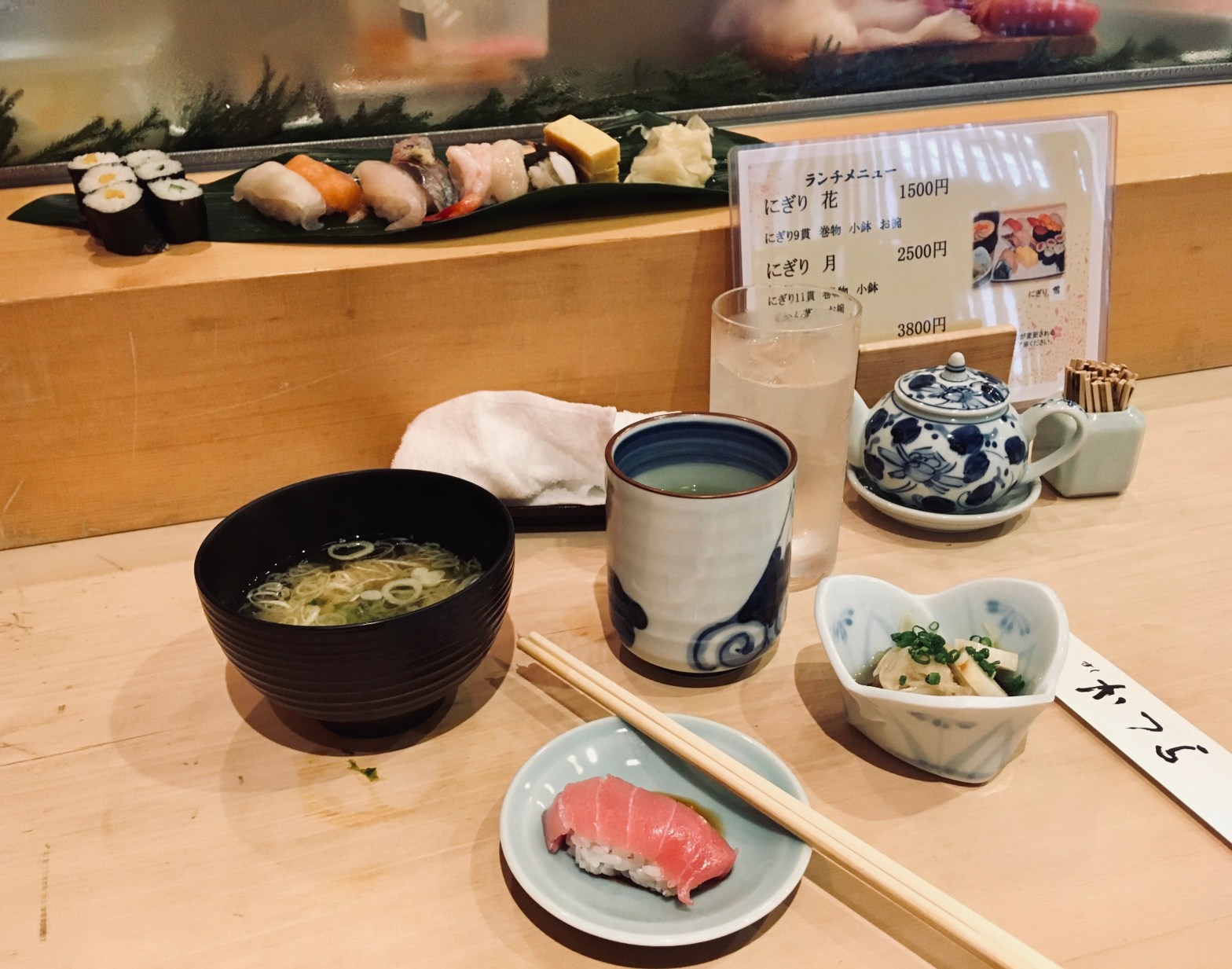
I had made a note of a small sushi restaurant on the outskirts of Tsukiji’s market. Pushing my luck as it was getting late for lunch, but with a rumbling stomach to rival a marching infantry of soldiers, sought out Sushi Katsura. Gloriously, it was – just – still open.

I was their last lunch guest. Menus are in Japanese only, but I knew that ichi means one so I swiftly pointed at the Ichininmae menu. I was sat at the counter, able to witness the itamae sushi chef’s delicate and precise handling of each piece of raw fish that I was about to receive. He exuded the calm demeanour of a man wedded to his craft.

Onto one end of a bamboo leaf went the maki roll, cut into six (the familiar kind with specks of cucumber and pepper inside), the line-up gradually expanding with each new nigiri sushi, until I had 15 pieces. Now, it’s relevant for me to say at this point that I’m not the world’s best eater of raw fish, but whatever the chef laid down I would have eaten out of politeness.

I needn’t have worried. Every morsel of nigiri sushi was phenomenal!

The palest, most delicate of ebi prawns, flush-pink and generously sliced maguro tuna, shimmering hamachi yellowtail fish. Those were the ones I knew I’d like, but even the saba mackerel (with a regal dollop of wasabi) and tako octopus nigiri were unceremoniously devoured faster than you can say arigatou gozaimasu. All thrown together with neat scrapings of gari ginger and lashings of soy sauce, accompanied with alternate gulps of miso soup and green tea.

While I might have missed out on visiting a world-class tourist attraction, here I’d encountered some of the highest quality fish from that day’s catch at Tsukiji.

A golden experience, worthy of any summer Olympics.

Photo Story: Alaska

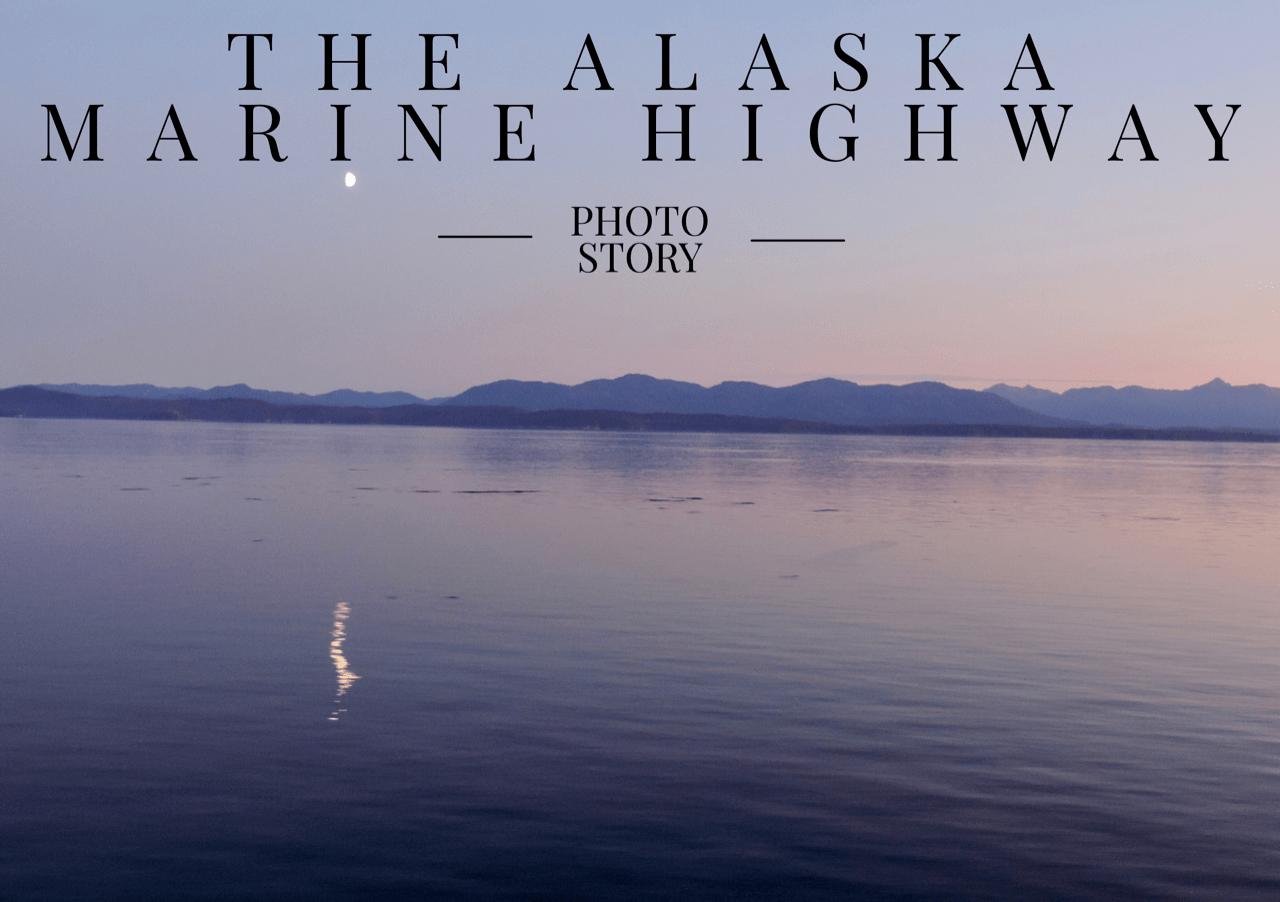
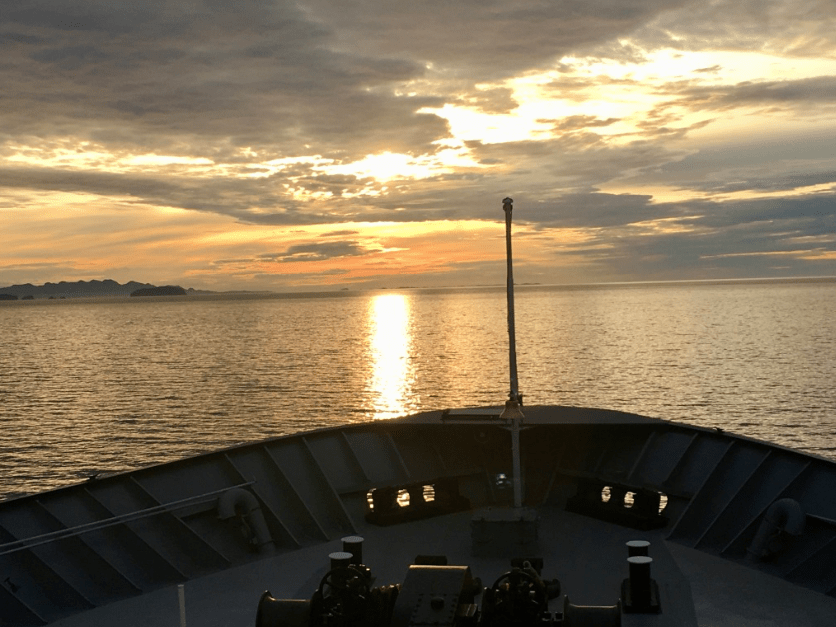
Lately, when daydreaming about memorable journeys, my mind’s eye has flown me out to the waters between British Columbia in Canada and the southern islands of Alaska. Replaying two harmonious days sailing on the Alaska Marine Highway. Back to the sublime sunsets, vast openness and full on freedom of the open water.

The Alaska Marine Highway is a state ferry service which covers 3,500 miles of spectacular coastline, from Bellingham in Washington state via BC’s Prince Rupert and Alaska’s southern Alexander Archipelago, along the south coast to Dutch Harbor in the Aleutian Island chain.

And it is a hell of a ride.

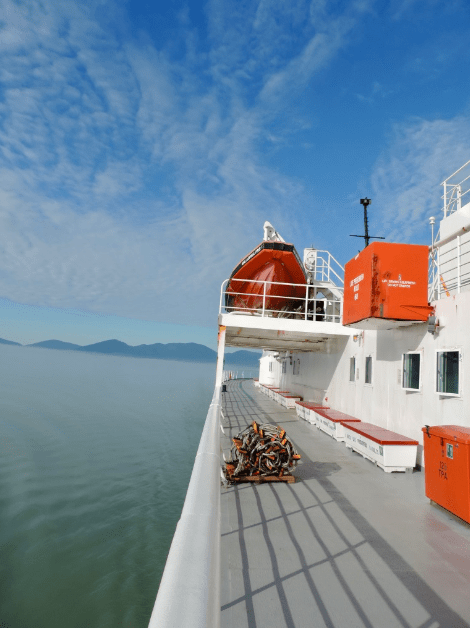
In the following photo story, I’ve captured a little of what it was like sailing on our vessel the Malaspina, some of what we saw and experienced.

Sailing over the Hecate

Hecate Strait

Our journey began on the evening of my birthday in early September last year. Leaving the Canadian coastal town of Prince Rupert behind, we sailed on the Hecate Strait. The beautiful archipelago of Haida Gwaii behind us and the Alexander Archipelago in our sights.

Cherry pie with cream

Birthday pie

I was very full after a stonking great seafood lunch at wonderful Dolly’s Fish Market in Prince Rupert (chowder followed by a halibut, shrimp and crab burger if you’re interested). But I made space for some cherry pie, generously plied with whipped cream when the restaurant staff found out it was my birthday!

Sun setting on our first evening

Entering the Alexander Archipelago

Our vessel the Malaspina had entered the Alexander Archipelago, a group of over 1,000 islands along the panhandle of Alaska’s south east coast. We would reach our first island stop of Ketchikan at 1am. Fast asleep!

On board on the morning of the second day

A Glorious Day

The start of a full day of sailing and it was shaping up to be a glorious day… I even took to the deck for a morning run, unheard of for me!

The Spatsizi Plateau Wilderness Provincial Park

Mountain views

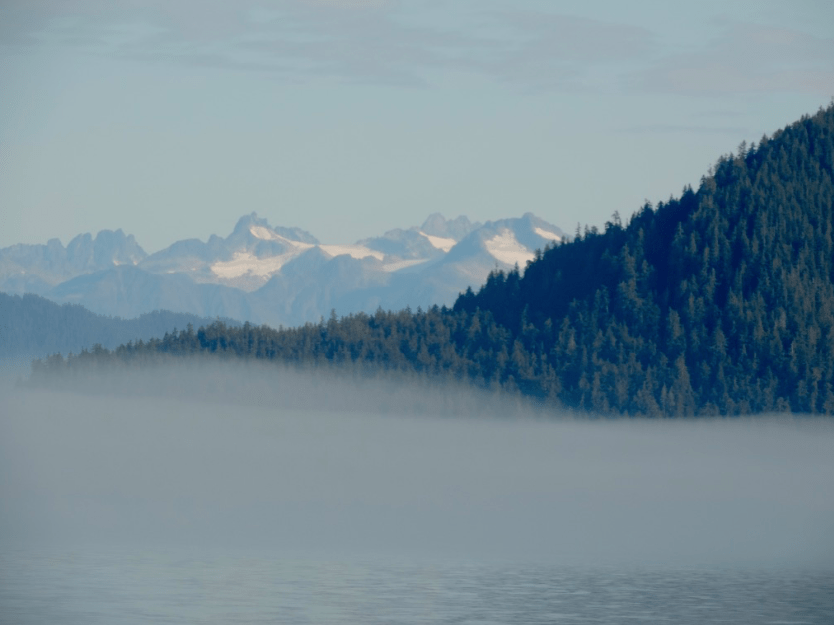
Although we were in Alaskan waters, views of northern British Columbia to the east trailed us along our passage. Here we glimpsed one of many mountain ranges in the Spatsizi Plateau Wilderness Provincial Park that stretch up towards the remote and sparsely-populated state of the Yukon.

A raven totem pole in the town of Wrangell

Wrangell totem pole

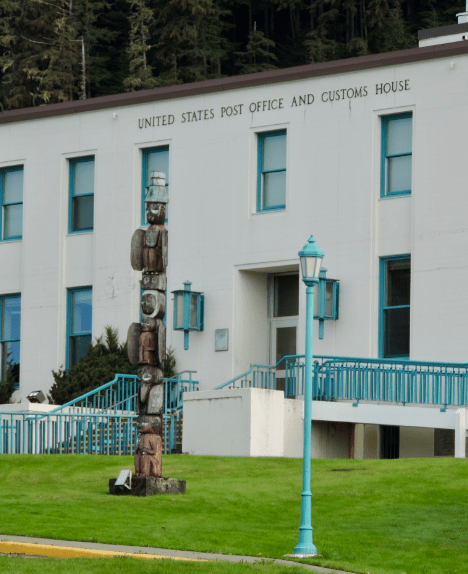
During ferry stops we were allowed to disembark, though we had to be very quick. Here, a raven totem pole made in the 1960s displayed outside the post office in the town of Wrangell (population 2,400).

For thousands of years the indigenous Tlingit people (meaning ‘people of the tides’) have called the Alexander Archipelago home. As their name suggests, the Tlingit have always been seafarers, skilled at fishing the Pacific Ocean and its surrounds.

Tlingit lands stretch beyond the Alexander Archipelago out to British Columbia, the south coast mainland of Alaska and into the Yukon.

First Nation Wrangell residents call themselves Shtaxʼhéen Ḵwáan after the nearby Stikine River.

A humpback whale dives
A humpback whale gliding through the water

Whale watching

Winds buffetting me so much at times that I couldn’t keep my camera steady, we at last met Alaska’s humpback whales. Why at last? Up to this point, I had only seen the brief sight of the fin of a humpback whale and her calf in the South Pacific Ocean. Over the second half of the journey, we saw humpbacks breaching and diving and gliding along. Every single spot was a thrill for me.

Sailing between Kake and Sitka in the Alexander Archipelago

Between Kake and Sitka

As the sun set so luxuriently on the second evening, we sailed deeper into the archipelago. After stopping at Kake (population 600) we began weaving our way to the larger settlement of Sitka (population 9,000).

This involved navigating eastwards round Kuiu Island and into the open waters of the North Pacific Ocean, later turning round westwards round Baranof Island.

Though Kake is quite small, it’s home to the third largest totem pole in the world. Fact! All 132 feet of it was carved in 1967 to commemorate 100 years since Alaska had been bought from the Russians.

Sunset over the Alexander Archipelago
Pastel skies above Alaska

The second evening

This is where my mind’s eye takes me most whenever my mind drifts: our second evening on the water. The softest and most serene sunset and moonlit skies I think I’ve ever witnessed.

Trees and clouds in the Alexander Archipelago
Still waters in the Alexander Archipelago

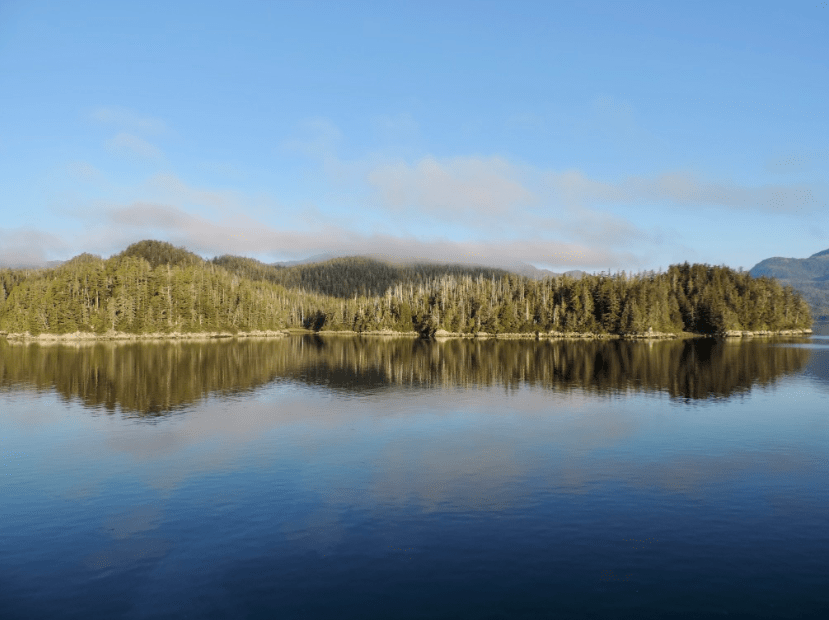
Tree reflections and mists

We’d reached our second morning. Despite inching closer to our end destination, the waters and surrounding landscapes still felt incredibly peaceful.

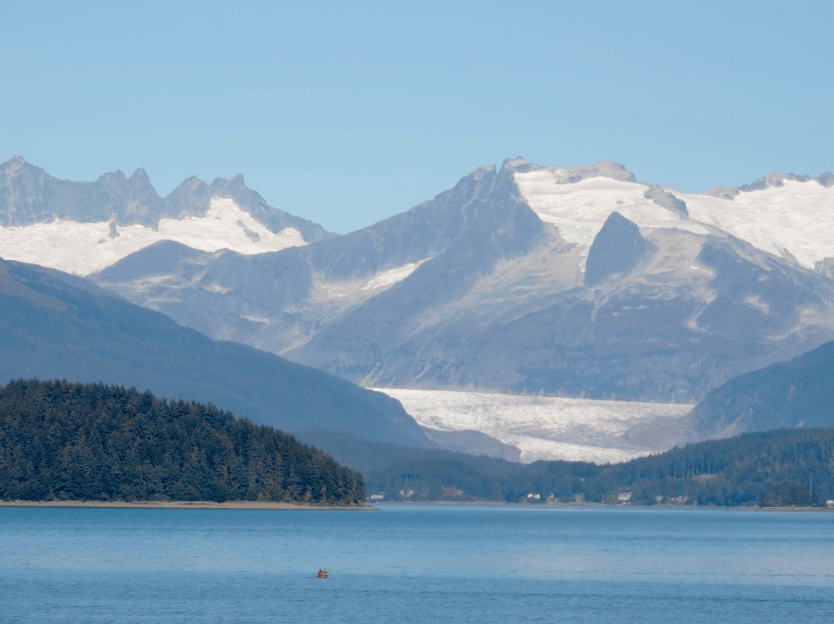
The Mendenhall Glacier in Juneau

Approaching Juneau

After a dreamy two days of sailing, our destination of Juneau was in sight, with its famous Mendenhall Glacier. Visiting later that day we didn’t spot the bears we hoped we might see, but instead hung out with sea eagles, migrating salmon and even a porcupine up a tree.

Two days of slow travel very well spent.

Should I stay or should I go?

Longer read

The world is opening up again. Well, bits of the world. And it’s got me thinking about where I want to go over the next few months. Read on for my opinion piece and scroll down to the bottom for some recommended destinations…

A conundrum

Photo by Ashley Batz on Unsplash

On Friday, UK quarantine rules were relaxed for holidaymakers and returning citizens travelling via so-called ‘air corridors’ or ‘air bridges’ from 59 countries.

Countries on the list include many European neighbours (though Portugal’s a glaring exception) as well as some long haul destinations including New Zealand, South Korea, Japan and Hong Kong.

Following this news, and as the travel industry asks us to travel further and wider, I’ve been asking myself something: should I stay or should I go? Do I give in to travel FOMO or join the UK staycation conga line? And if I stay in the UK, where do I really want to go?

I decided to look at both sides and weigh up my options…

Part I: travelling abroad

Inside Man Mo Temple in Hong Kong

The UK government’s air bridges are one thing, but each country has its own rules. In Iceland for example visitors must take a test or quarantine for 2 weeks, and for others the relaxation of rules applies only to its citizens or those with visas. New Zealand immigration states that its border is ‘currently closed to almost all travellers wanting to travel by either air or sea’.

Meanwhile, news of what travelling abroad is actually like at the moment has been mixed.

Alongside reports of reduced numbers on flights, breezy check-ins and empty iconic landmarks, there have been less than welcome stories and headlines in the past few days: ‘Brits left sleeping on beaches after hotels found closed’, Italian beaches labelled a ‘paradise from hell’ as social distancing struggles to be upheld, huge traffic jams heading for Croatia, just as it announced a record number of infections.

And yet. There’s just nothing quite like the pull of a faraway, remote or just ‘different’ destination. If rules permit, it seems inevitable that more of us will consider heading abroad for whatever escapism we can find, whether we’re tempted by booking offers and refund promises or a bad case of cabin fever and itchy feet.

On Friday i paper reported on an Office for National Statistics survey detailing that less than 10% of UK adults are likely to travel abroad in the coming months. However, those who have so far made it abroad report tourist numbers more like April than July.

It’s a tantalising prospect, a beautiful beach or world famous landmark like the Alhambra fortress in Granada almost to yourself..

Part II: staying in the UK

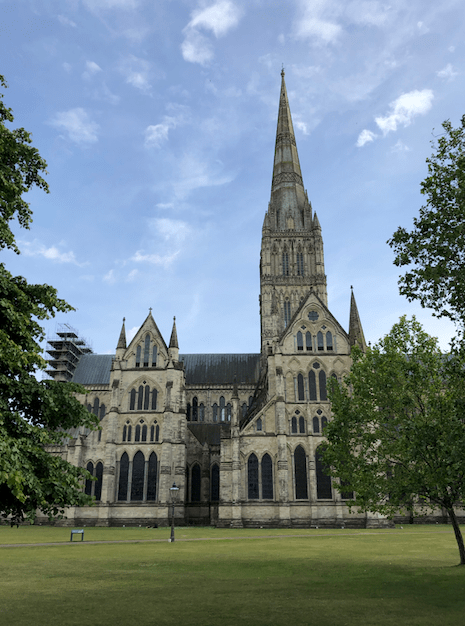
Salisbury Cathedral

In the same survey, around a quarter of adults said they would be going on holiday in the UK. That still leaves a significant chunk of the UK population who are either undecided or resolute that they will stay put. Which is very worrying for the UK hospitality and travel industry, already on its knees.

However, some areas of the industry are doing well. Cottages and campsites have reported big upsurges in bookings since late June, with numerous companies reporting selling out until September. Many travel operators have needed extra time to prepare following the recent changes in government policy, which means we’ll see more availability and opportunities to travel. And as for England’s beaches…

My first post-lockdown foray to the coast was a cliff top walk between Weymouth and Lulworth in June. We struck lucky with gorgeous weather and the walk was fairly quiet most of the way. A glorious picnic on White Nothe cliff and a speedy zigzag down the steep Smuggler’s Trail, completely alone. Alone, that is, until we reached the bustling beach around Durdle Door. This was days before thousands descended on the beach, an event that launched a thousand articles on the resulting abusive behaviour and bad toilet habits.

But there’s more to the South West than a couple of insanely popular tourist hotspots. The same goes for the UK as a whole. It’s just about doing your research and getting there. The journey, not just the destination. And for me, it’s a journey that may solely rely on public transport, as I don’t drive.

But, hey, I like a challenge.

Decision made

Stockholm

I started today torn between two travel mindsets. Fearing that I’m missing out on an opportunity to discover countries in a way I probably won’t be able to again – and the same feat that I’ll miss a golden opportunity right here in the UK.

Traditional holiday destinations outside the UK need our support, but I think we have all come through lockdown more appreciative of what’s just beyond our doorsteps. There is a true excitement to exploring our own home turf, whether we find ourselves living in familiar lands, or distant.

There is a massive opportunity, too, to assess our personal impact on the planet and climate. Slower travel, like slower living, is more desirable than ever before, and I do think there is already a tidal shift in our attitudes towards reducing our carbon footprint.

Right now, the allure of what’s closest to home is strongest for me. Which is handy because I’ll be in East Sussex visiting family next week! Coastal walks, wildlife, outdoor swimming, fish and chips. Heaven.

I’ll tell you my plans for 2021 another time…

On the wish list

Galway

© Rory Hennessey on Unsplash

Galway is 2020 European Capital of Culture and it’s such a blow that a lot of their quality programming can’t go ahead, although they have permission and funding granted to extend into 2021. I had to cancel my May visit, but I hope to rebook and still make it there.

Shetland

Nesbister Böd on Shetland, © Visit Shetland

Lundy

View of Lundy © Leah Tardivel on Unsplash

Outer Hebrides

The Uists, Outer Hebrides © Andrew Buchanan on Unsplash

Can you sense a running theme?!

And some of my favourite wild places

Inner Hebrides

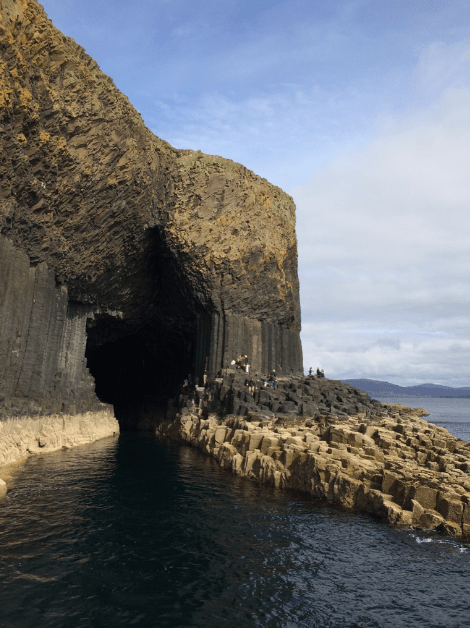
Fingal's Cave at the island of Staffa

They’re close enough to the mainland that you can spend a week or less exploring, which will never feel like enough time! On Mull you can live among soaring golden eagles, join a marine life boat tour and visit the basalt rock splendour of Staffa, or wander around peaceful Iona with its 1,500 year old Abbey.

I wrote a bit more about Mull in a piece on Awesome Island Getaways a few years back.

Best time: September

Hadrian’s Wall

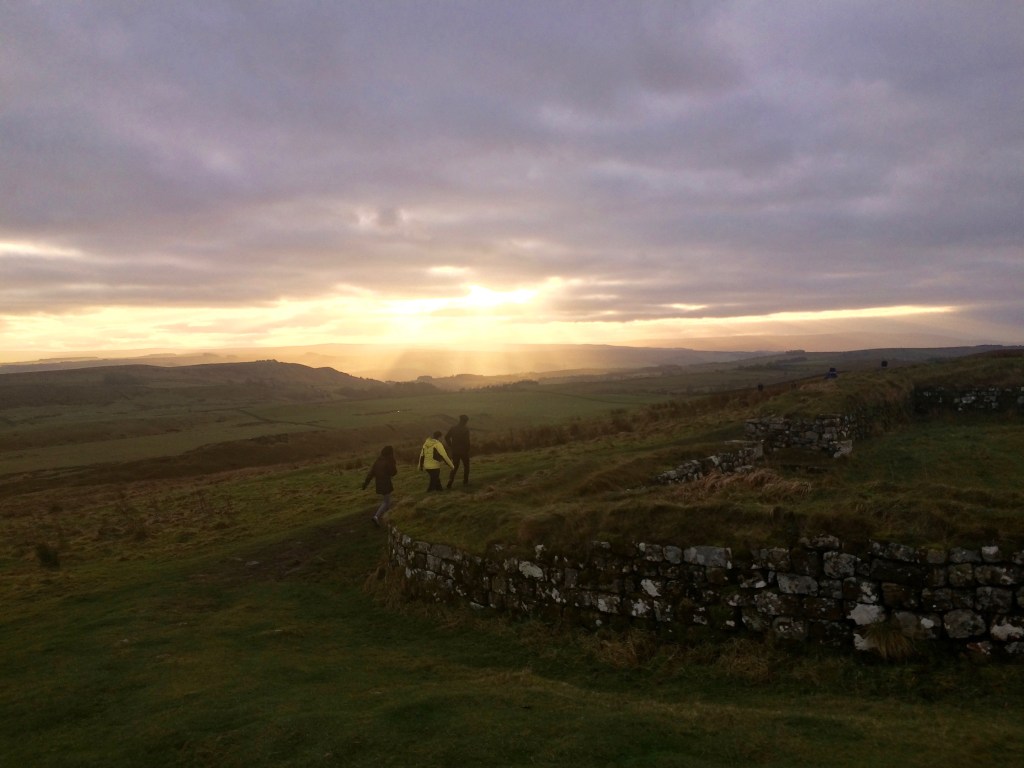
Milecastle 37 of Hadrian’s Wall

Running 80 Roman miles long and dating back to AD 122, Hadrian’s Wall makes for spectacular walking, perhaps especially when the landscape and weather is moody, stormy. If you’re not sure where to start, Milecastle 37 is one of the best preserved guarding gateways and this walk takes you to the famous Sycamore Gap tree that features in Robin Hood Prince of Thieves. And you’ll find walks along wilder sections of the wall here.

Best time: Autumn-Winter (for extra breathtaking)

The Jurassic Coast

Walking over White Nothe Cliff

The best walking in the South West, and England’s only World Heritage Site. Skirt the more crowded spots of Durdle Door, Bournemouth beach and and Lyme Regis (great as they are). Aim instead for the walk between Osmington Mills and White Nothe (which starts at the brilliant Smugglers Inn pub), which includes the steep descent and ascent of the smugglers’ path, if you’re feeling brave. Or the Isle of Portland is wonderfully windswept, and for a beach I recommend Chesil Beach on the other side of Weymouth to Durdle Door. It’s way less touristy and far bigger.

Best time: all year

Cornwall

Along the Penwith Heritage Coast

Everyone will have their own favourite corners of Cornwall and for me, the stretch of cliffs and crags known as the Penwith Heritage Coast has some magnificently memorable areas. From Portcurno beach and the famous open air Minack Theatre to the beautiful countryside around St Just and the quiet heritage of the Geevor Tin Mine. One day I’m keen to get to Lizard Point, Britain’s most southerly tip.

Best time: all year

Postcard from…the Amazon Rainforest

Longer read

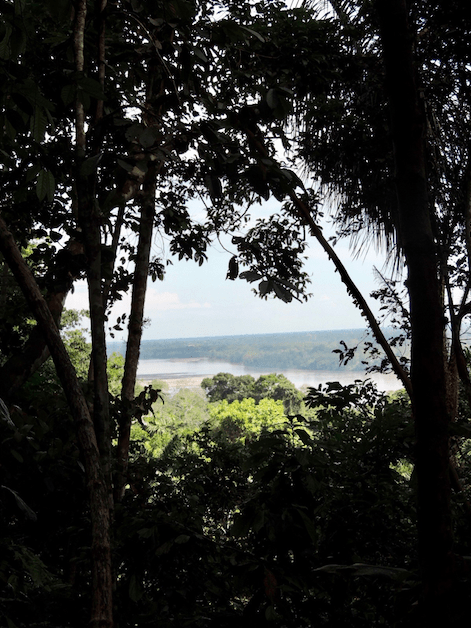
When I took this photo I remember thinking that it was like we were gazing out of a window, from one powerful life source onto another. We were in remote Yasuní National Park, a protected corner of Amazonian Ecuador and we were looking out onto one of the mighty Amazon River’s tributaries, the Río Napo.

It was 9.17 in the morning and we’d soon be lost in the Amazon Rainforest.

But before I get onto that…

Adventure

The most adventurous day of our Amazon Rainforest trip began at 5am, stirred awake in our cabins by a marching band of howler monkeys. Their sound is often likened to the roar of an oncoming train. I would go further and say they sound like an entire Clapham Junction station of oncoming trains.

We had arrived less than 24 hours before at our temporary home of Sacha Lodge, one of a number of smart rainforest lodges that are popular with those who can properly afford them (i.e. retired groups) and a few youthful chancers, like us. ‘Sacha’ in the Quecha Indian language means ‘forest’ and this ‘Forest Lodge’ was launched in 1992 by a Swiss man named Benny, who had visited Amazonian Ecuador in the 1970s.

In its launch year, Sacha Lodge comprised 1,200 acres of land and six guest rooms. Benny kept the land purchases going, and today the lodge sits within 5,000 acres of land. Nearby Napo River runs at over 1,000km in length, crossing the entire length of Amazonian Ecuador and beyond, finally feeding in to the Amazon River in neighbouring Peru.

Waterways

Travel between Sacha Lodge and the Napo River is by traditional dugout canoe, carved from tree trunks in the traditional way. Still very early, we crossed inky Pilchicocha Lake – mosquito free because of the tannins in the water – with our keen naturalist guide and Quito native, Gus.

Retracing our steps along the forest-edge boardwalk, we encountered more red howler monkeys (this time launching between trees above our heads) and some almond-scented armoured millipedes. A beautiful arthropod, just going about its day.

Transferred now into an electric canoe, we coasted down the vastness of the Napo, stopping on the Yasuní boundary at a riverbank ‘clay lick’. Many birds, as well as mammals, rely so much on the abundance of nutrients and minerals in cliffs of clay like this. We saw Mealy Amazon and Blue-headed parrots, Dusky-headed parakeet and Chestnut-fronted macaws. A skittish sea of green above a silty ribbon of river.

We had made it as far along the Napo as we would be going, now within the protection of Yasuní National Park. The park became a biosphere in 1979 and later a UNESCO Biosphere Reserve. Pristine, in part, but also staring into a dangerous future.

Under threat

Traces of the oil industry and illegal logging weren’t too hard to spot on our travels. The gateway city of Coca along the Napo River grew out of the oil business, and we saw shady signs of industry dotted about on the riverbanks on our way to Sacha Lodge.

Fast forwarding to spring 2020, huge levels of erosion and oil spills have been reported along the Napo and Coca rivers. Bound to this sad story of erosion, Ecuador’s largest waterfall, San Rafael, disappeared in February.

Among the people most affected by a trio of threats – climate change, oil and illegal logging – are Amazonian tribes, including the Waorani. In 1990 they won the right to a reserve of land that overlaps with Yasuní, but have had to fight hard in recent years in particular to halt the government’s oil drilling agenda.

There is hope though.

Last year Waorani from Pastaza, south of Yasuní, won a landmark legal victory which means that half a million acres of land are protected from oil exploitation.

Around the same time we visited, cameraman and naturalist Gordon Buchanan lived with a group of Yasuní Waorani who venerate anaconda snakes. Despite the dangers, they search for green (aka common) anacondas, catching and releasing them (humanely) in a show of strength but also affection. With them, Buchanan uncovered one of the biggest anacondas on record, a whopping 5.3m long!

A silent race

What struck me most as we left our boat and set off walking was how varied all the plants and trees were. Sounds obvious but it immediately felt different to the ground-eye view at the more accessible Sacha Lodge. You could feel a remoteness attached to every step.

Pointy fronds, pencil thin many-trunked trees and spotty leaves, stencilled by leaf cutter ants. Trees with spindly, twisty vine-like branches or giant jagged leaves. The occasional fiery stem of a bromeliad flower, poking out among 1,000 shades of green. Casual flypasts of large butterflies like the lustrous Menalaus blue morpho butterfly, impressive and bird-like in size. Or the Brown owl moth, so called for the huge eyespots on their wings.

The further we walked, the closer together and taller everything got, embraced in a silent race to reach the canopy first. Some of the loftiest were the gigantic Kapok, or Ceiba, trees. Even the younger ones had roots the size of marquees. Immense and Jurassic, their bases looked to me like a series of dinosaur claws.

And always the hum of insects.

Creatures small and great

All four of us were covered in all manner of insect repellent, almost as if taking part in a laboratory trial. I wore Avon’s Skin So Soft spray, which features natural repellent citronello, completely coincidentally. The Royal Marines are rumoured to use it.

Mosquitoes can seem to either like or dislike your natural scent – even your blood type. I don’t think they liked either of mine much, I was barely bitten. Two of my friends, however, seemed to be top prize. Manu in particular was under constant attack from dive-bombing females (the ones who actually bite), his bloodied and ripped shirt a testament to their tenacity. Not all the wildlife was trying to eat us though.

We saw and heard four species of monkey – Poepigg’s woolly, Red howler, Golden and Black-mantled tamarin – and we caught the whisper of a highly venomous Fer-de-lance pit snake as it slinked off to even quieter depths. Spiders sometimes spotted clambering over leaves.

We crossed ways with a Yellow-spotted river turtle and False coral snake, non-venomous despite their alarming, neony colours. Meanwhile, we learned a big story about tiny ‘Lemon’ ants.

An hour into our walk we came upon a strange clearing known as a Devil’s Garden, so-called because in the mythology of the Amazon Rainforest it’s thought that evil forest spirits called Chullachaki or Chuyathaqi inhabit them, killing the plant life around them.

A clearing without trees might not seem odd, but in such dense rainforest, it is. The scientific answer? Those Lemon ants. They use their own herbicidal poison on plants and trees they don’t eat, only leaving the species they savour. Some Devils’ Gardens have been known to grow to the size of hundreds of trees with millions of ants and thousands of queens.

Although these local superstitions mean that tribes would be wary of coming into such clearings, we huddled round a colony and took turns to try a couple of the ants. Mine tasted just like sherbet.

There and back again

Enjoying such awesome encounters with wildlife, and happily ambling along as we had been for hours, we jumped down onto a shallow, rocky riverbed. One that looked a bit familiar.

With a dread realisation that trickled over us in turn, we knew we had crossed this river already, I’d even taken a group photo hours before. A hut along the trail was meant to mark a turning point but we’d missed it somehow. Our guides had suspected as much before the river, they just hadn’t let on. The four of us assumed we’d been advancing in the right direction, but here we were off-trail, having gone in the wrong kind of circle for who knew how long.

I wasn’t too worried at first. We were with experienced guides, one of whom lived in the rainforest. They had marked our route using their machetes, and we could surely retrace our steps and look again for the turning. It wasn’t too late in the afternoon.

But rainforests are fickle friends, unwilling to let you go in a hurry. And as the name suggests, they don’t really stay dry for long.

The weather was changing and sounds of thunder in the distance poked at our ears – a very unwelcome storm was approaching. We couldn’t tell how big, but we knew enough about the risk to visualise our tracks washing away in heavy rain, perhaps a night spent sheltering beside a giant tree.

When you realise you’ve ‘gone wrong’ somewhere remote, certain thoughts can seem to run around your mind carousel-like, over and over. Our water bottles no longer looked sufficient. Our last meal had been a few lemon ants. No-one outside of our group knew our exact location. Our guides weren’t smiling any more.

And rain, heavy and warm, had arrived.

But it sprang our tired limbs into action. No, it was too risky to aim to find the missed turning. Yes, it was much safer to follow our steps back and hope the storm was brief. We forgot our hunger and our encroaching thirst. We hastened to follow our guides, feeling apprehensive and increasingly soggy, but determined to walk fast and find our way back.

Found

The next few hours were a bit of a blur, as return journeys sometimes are. Nerves were jangling, hoping the weather would clear, looking for signs we had rejoined the trail, wondering if we’d retraced earlier movements yet.

Looking at all my photos from the day, there is a gap of over two hours where I took nothing, camera stowed away from the rain. It rained on us for a while, we heard thunder, perhaps even saw some lightening, but the storm worked out to be the kind that passes over quite swiftly, leaving you clothed in mist and humidity. Praise be.

By a certain point I was quite sure we’d landed back on the trail. Spotting the eerie ’Devil’s Garden’ clearing gave me a kick of adrenaline. My friend Preeti took some convincing, but, finally, at 2pm, after 5.5 hours exploring and getting lost in Yasuní National Park, we came upon a view that everyone could agree on.

We were back at the rainforest window among the trees.

Which meant we were 45 minutes from our canoe. Looking out from that window a little more wisely, and a little more thankful.

Postcard from…the Venetian Lagoon

‘Kim, do you think we’ve got time to see Igor Stravinsky before we go?’

No, my friend and I hadn’t travelled back in time to meet the 20th century Russian composer of The Rite of Spring. We were on Isola di San Michele, Venice’s cemetery island out in the lagoon. And time was running out to explore it before the last water bus of the day departed.

You could describe the island – which is actually two islands linked by canal – as a symbol of Napoleon’s military might. He invaded and dissolved the Republic of Venice in 1797, sanctioning a few years later for burials to take place away from the oft-flooded centre of Venice. Even despots can possess a regard for hygiene, then.

In any case, the history of the island predates Napoleonic upheaval. It is named after the church of St Michael that was built there, the first Renaissance church in Venice. A monastery was home to a branch of Benedictine monks and there was even a prison on the island for a time. Different kind of home I expect.

If you look at a picture of the island from the sky everything looks so ordered, like scaled up vegetable patches. But on the ground, once through the entrance it doesn’t feel that way, and you really forget you’re surrounded by water. A very thoughtful place.

We had time to visit Stravinsky’s grave in the end, and those of his neighbours: expat American poet Ezra Pound, Ballet Russes founder Sergei Diaghilev, writer Joseph Brodsky – and Venetians from all walks of life. It’s less starry than Père Lachaise Cemetery and the map isn’t entirely accurate, but it adds to the casual glamour of the place.

As you’d expect from a working cemetary, you can’t take photos within the walls, though if you’re lucky as we were to catch a sunset on the way back, you’ll find it compensation enough.

And what if we had missed the last water bus? Well, we would have been in good company.

Postcard from… Banff Town

Idyllic even in the rain. I loved everything about Banff National Park, from the springing deer crisscrossing our campsite to the piping sounds of golden-mantled ground squirrels all around. The misty mountains, the endless trees, even the heart-thumping thrill that a grizzly might be round any corner, searching for berries (or worse).

Banff was Canada’s first national park, established 135 years ago in 1885. Not long after, Chateau Lake Louise was built and the park’s renown with tourists was secured.

What I most loved about Banff wasn’t really the famous Lake Louise, thousands-of-selfies part though. The adventure and wilderness were the highlights, but the warm, buzzy atmosphere of Banff Town was just as memorable.

We were far away from home, but feeling at home.

We’d pass through the town on our way out to explore a lake or we’d return, exhausted and a bit muddy, from hiking a mountain trail and it would just feel like the town was giving us a big hug. A feeling that’s not easy to pin down.

The only exception to its charms? That would have to be the random late afternoon ‘lunch breaks’ all the bus drivers would take, seemingly at exactly the time we wanted to catch a lift.

But that’s the great thing about staying in any friendly country – hitchhiking!